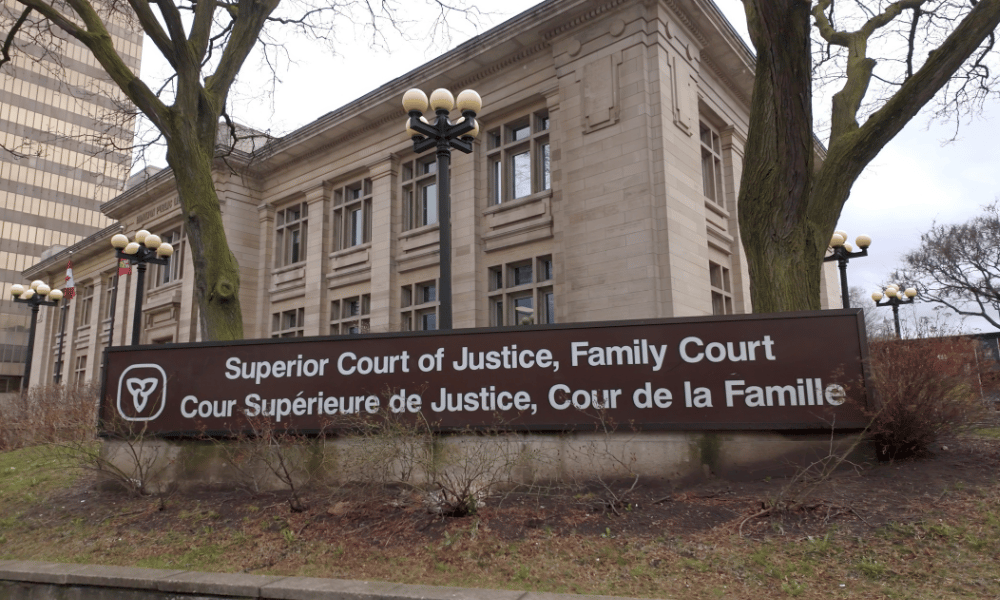

Judge stays negligent investigation claim, but not malicious prosecution claim, against police board

In proceedings against the Barrie Police Services Board arising from two workplace investigations involving a uniformed police officer, the Ontario Superior Court of Justice stayed a negligent investigation claim, but not a malicious prosecution claim.
In Gardiner v. Barrie Police Services Board, 2026 ONSC 5753, the defendant board employed the plaintiff police officer, who began working for the Barrie Police Service in 2005 and became a sergeant in 2020.
The Barrie Police Association represented the plaintiff’s bargaining unit. Under Ontario’s Labour Relations Act, 1995, the association and the defendant executed successive collective agreements that governed the plaintiff’s employment relationship.
According to the plaintiff, he started a personal relationship with another police officer (DC Beard) in 2015 and discovered that she had sexually explicit photographs or videos on the internet, leading to a workplace investigation of her activities.
The investigation determined that:
In a subsequent investigation, the defendant board asserted that the plaintiff had been suspended pending an internal workplace investigation with allegations of professional misconduct and inappropriate behaviour with a female colleague.
Given the evidence that emerged of a potential criminal offence, the defendant board said it shared the internal investigation findings with a Crown attorney.
In an action initiated against the defendant board on Feb. 14, 2025, the plaintiff alleged:
According to the plaintiff, he was arrested and charged with criminal harassment and extortion under the Criminal Code, 1985, on or about Feb. 4, 2022.
The plaintiff requested general, special, and punitive damages.
In its defence delivered on March 21, 2025, the board argued that the plaintiff could not proceed with his action before the Superior Court.
The Superior Court denied a motion to stay the malicious prosecution claim upon determining that it had jurisdiction over this allegation.
The court pointed out that the defendant board did not dispute that the plaintiff had alleged the four elements needed for a malicious prosecution claim, as stated in Nelles v. Ontario, 1989 CanLII 77 (SCC), [1989] 2 SCR 170.
The Superior Court granted the motion to stay the negligent investigation claim for seven days to enable counsel to set an appointment to make submissions on whether Correia v. Canac Kitchens, 2008 ONCA 506, and Lee v. Magna International Inc., 2022 ONCA 32, bound this court.
Citing Correia and Lee, the court found no tort liability against an employer investigating its employee.
Based on those Ontario Court of Appeal rulings, the Superior Court said the plaintiff could not maintain his request for declaratory relief and damages flowing from the workplace investigation, as the defendant board could not be liable in tort for the conduct of its internal investigations.
Regarding the statutory regime under Part V of Ontario’s Police Services Act, 1990 (PSA), the parties disputed whether the PSA and the collective agreement constituted a “complete code” regarding police discipline.
The Superior Court found it unnecessary to decide whether there was compliance with the PSA’s complaints and disciplinary regime.
The court reiterated that the Correia and Lee decisions would be binding unless the parties’ counsel could submit other authorities convincing it otherwise.
In two wrongful dismissal actions, the Ontario Court of Appeal issued an Aug. 6 ruling in the employers’ favour upon determining that the employment contracts’ termination provisions complied with the minimum entitlements required under the province’s Employment Standards Act, 2000.
On Mar. 18, 2025, the Superior Court found that it lacked jurisdiction to adjudicate the applicant’s complaints arising from the termination of his life membership in a union, given that these matters of policy were deemed not justiciable.
Enjoy this story? Read the latest labour and employment law news on the main page!