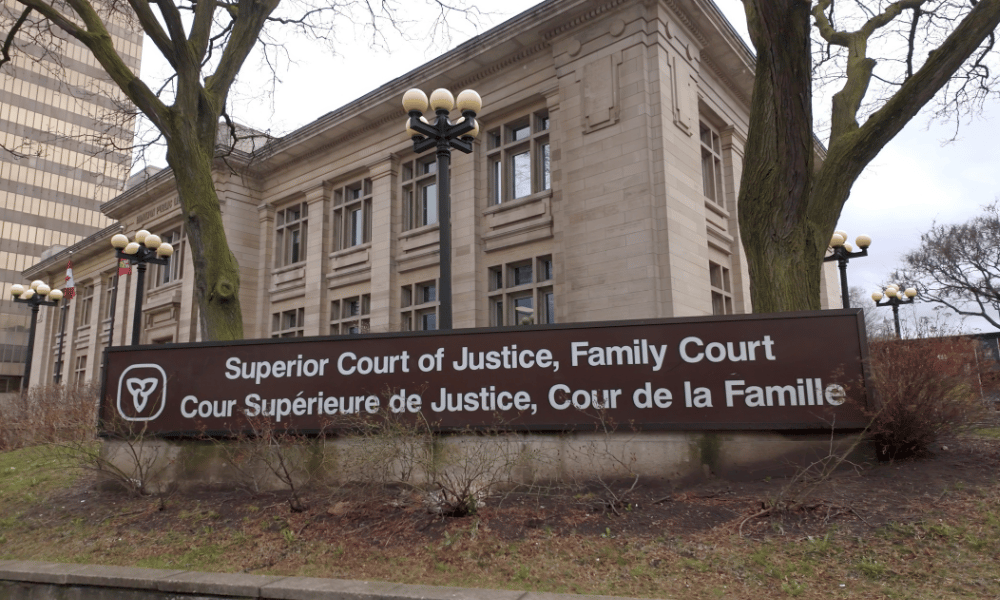

The ruling is the first time the OCA has interpreted 2016 changes to the Children’s Law Reform Act

A man who was conceived through artificial insemination is entitled to a share of his non-biological father’s estate, the Ontario Court of Appeal ruled Tuesday, noting that the case represents the first time the court has interpreted a set of decade-old rules for determining parentage in Ontario.
In 2016, the province amended the Children’s Law Reform Act, which addresses issues related to children of unmarried parents, including those in common-law relationships. The amendments include clauses stating that when a parent conceives a child via assisted reproduction or insemination by a sperm donor and has a spouse at the time of the child’s conception, that spouse will legally be considered one of the child’s parents.
These rules do not apply, however, if the spouse did not consent to be a parent or withdrew their consent before the child’s conception.
In its ruling in Edmonstone Estate v. Weisbrod, the OCA clarified for the first time that these rules apply retrospectively. The appellate court also found that once a birth parent’s spouse has been recognized as a child’s parent, it is up to the party challenging that designation to prove that the spouse did not consent to being a parent before the child’s conception.
Any evidence that speaks to the spouse’s intentions – or changes in intention – after the child is conceived “is only relevant to the extent that it sheds light on pre-conception intent,” the OCA added.
The case involves an Ontario man, Bradley David Edmonstone, who died in 2022 without a will. Edmonstone had two biological children with a former spouse, and later tried to conceive a biological child with his common-law partner, Lorraine Weisbrod, when they were together between 1998 and 2007. However, Edmonstone had previously had a vasectomy.
After several attempts to reverse the vasectomy failed, Weisbrod conceived using a sperm donation, giving birth to a son, Jake, in 2004. Edmonstone signed documentation related to Jake’s birth, including a birth certificate, as Jake’s father. When he and Weisbrod separated, he continued to identify himself as Jake’s father in family court proceedings, and paid child support for Jake until his death.
When Edmonstone died, one of his biological children, Jennifer Grosvenor, became the trustee of his estate. She argued in court that Jake was not entitled to a share of Edmonstone’s estate. The trial judge in the case agreed, based on evidence that Edmonstone was not involved in the process of Jake’s conception via sperm donation, did not have parenting time with Jake after 2009, and had questioned the use of his last name on Jake’s birth certificate.
The trial judge’s ruling also relied on a 2013 email exchange between Edmonstone and Weisbrod, where Edmonstone refused to pay for special expenses related to Jake by telling Weisbrod, “You forget he’s not my kid. You want him. Live with it.”
In its ruling released Tuesday, the OCA agreed with the trial judge’s finding that the 2016 amendments to the CLRA applied retrospectively.
“The amendments expand the definition of parents and children in Ontario by ensuring equality, irrespective of family form or method of conception,” the OCA said. “Nothing in the legislation itself or the statements of the government at the time of enactment could support an interpretation that equality was intended only for children conceived after the 2016 amendments entered into force.”
However, the appellate court disagreed with the trial judge’s finding that Weisbrod and Jake bore the burden of proving that Edmonstone had consented to being Jake’s parent. The goal of the CLRA amendments was to expand the definition of a parent under Ontario law; the law assumes that when a birth parent conceives a child via artificial insemination, that birth parent’s spouse is also the child’s parent. Establishing an exception to this rule requires proving that the spouse did not consent to being a parent before the child was conceived.
Whenever someone seeks “to benefit from a statutory exception,” they “must establish that they come within its terms,” the OCA said.
“Thus, the party wishing to show that the… exception applies bears the onus of showing that the birth parent’s spouse did not consent or withdrew consent before the child’s conception,” the OCA said.
The appellate court added that “while a declaration may be sought and obtained, nothing in the CLRA requires legal parentage to be confirmed by way of a declaration to take effect.”
Turning to the evidence that the trial judge used to reject Jake’s claim in Edmonstone’s estate, the OCA concluded it was “exceedingly thin” and partly inadmissible.
The appellate court declared that Edmonstone was Jake’s parent and confirmed that he is entitled to a share of the estate.
In a statement, Cambridge LLP associate Quinn Giordano, who represented Weisbrod and her son, said Tuesday’s decision “provides important guidance and clarification for family law and estates lawyers across Ontario.”
A lawyer for Grosvenor was unable to respond immediately to a request for comment.